Skin aging is a natural process, but changes in facial firmness, fine lines, and jawline definition can make many people look for ways to refresh their appearance.
Not everyone wants surgery, injections, or procedures that require several days of recovery.
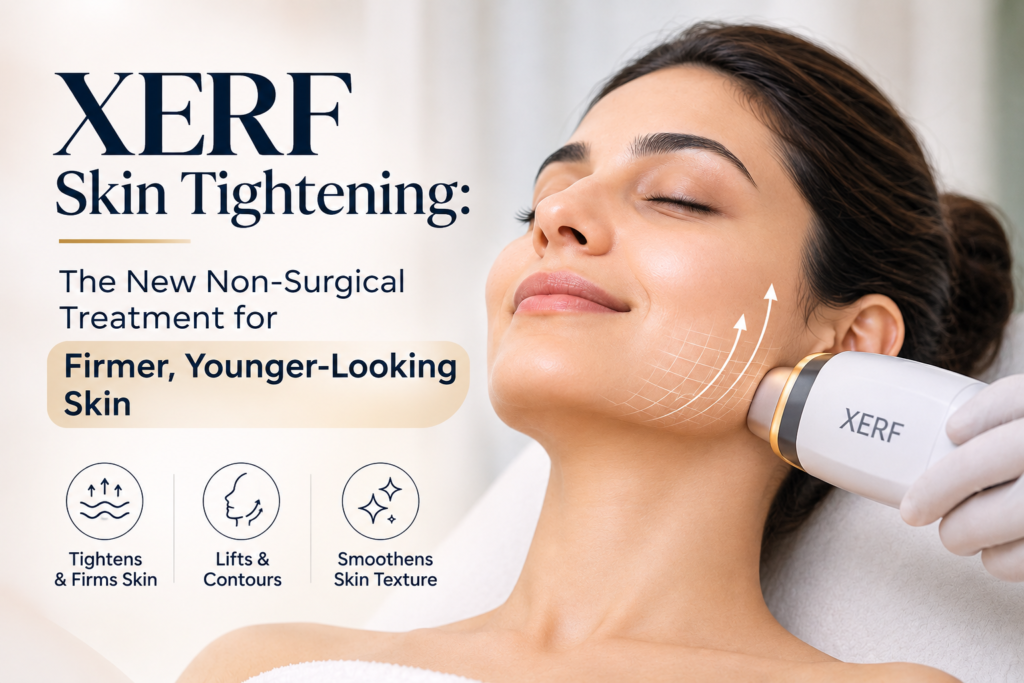
This growing interest in non-invasive aesthetic treatments has brought attention to XERF skin tightening, an advanced radiofrequency technology designed to improve the appearance of facial skin laxity.
XERF uses dual-frequency radiofrequency energy to heat targeted tissues at different depths. This controlled heating encourages collagen remodeling, which may gradually improve skin firmness and facial contours.
But how effective is XERF treatment? Is it painful? And how does it compare with traditional skin-tightening procedures?
Here is what you should know before considering XERF.
What Is XERF Skin Tightening?
XERF is a non-invasive radiofrequency treatment developed by Cynosure Lutronic that uses two frequencies—6.78 MHz and 2 MHz—to deliver controlled energy into targeted tissue layers, supporting collagen remodeling and skin tightening.
Unlike surgical procedures, XERF does not require incisions or stitches.
It is designed to deliver radiofrequency energy to different tissue depths through specialized treatment settings.
The goal is to improve mild to moderate skin laxity and support a firmer-looking facial appearance.
XERF is sometimes described as a structural skin-tightening treatment because its energy delivery is intended to affect multiple layers involved in skin support.
However, the visible degree of lifting varies among patients, and XERF should not be considered a direct replacement for a surgical facelift.
How Does XERF Skin Tightening Work?
XERF works by delivering controlled radiofrequency energy into tissues, producing heat that initiates collagen remodeling.
Collagen is one of the main structural proteins responsible for the skin’s strength and firmness.
As collagen and other supporting structures change with age, skin gradually loses elasticity and facial contours can appear less defined.
XERF uses several technological features to address these concerns.
1. Dual-Frequency Radiofrequency Technology
XERF combines two radiofrequency frequencies:
- 6.78 MHz: Contributes to controlled heating of targeted tissues.
- 2 MHz: Has different tissue-interaction characteristics that can support deeper energy delivery.
By combining the two frequencies, the system is designed to treat multiple tissue depths.
2. Three Depth Settings
XERF provides three depth settings that allow the practitioner to customize energy delivery for different anatomical areas and patient needs.
The appropriate depth depends on facial anatomy, tissue thickness, treatment goals, and clinical assessment.
3. Controlled Cooling Technology
XERF uses Integrated Cryogen Delivery cooling technology to help regulate skin-surface temperature during treatment.
Its Wave Fit pulse technology also helps control energy delivery.
These features are designed to improve treatment comfort and reduce the risk of excessive surface heating.
4. Collagen Remodeling
The controlled thermal effect can cause changes in existing collagen and stimulate longer-term tissue remodeling.
Some patients may notice an early tightening effect, while additional improvements can develop over the following weeks and months.
In simple terms, XERF uses controlled heat to encourage firmer-looking skin without cutting or surgically lifting facial tissues.
What Are the Benefits of XERF Skin Tightening?
XERF has attracted interest because it combines customizable energy delivery with a non-invasive treatment approach.
1. Improved Skin Firmness
XERF may help improve the appearance of mild facial skin laxity.
This can be particularly relevant for patients who have started noticing changes in their cheeks, lower face, or jawline.
2. Improved Jawline Definition
Collagen loss and changes in facial supporting tissues can make the jawline appear less defined.
XERF may provide a modest improvement in lower-face firmness in appropriately selected patients.
3. Reduced Appearance of Fine Lines
Some fine lines become more noticeable as skin firmness declines.
By supporting tissue remodeling, RF treatment may improve the appearance of selected wrinkles.
4. Non-Surgical Treatment
XERF is applied externally to the skin and does not require surgical incisions.
This makes it an option for patients who prefer to avoid surgical procedures.
5. Little or No Routine Downtime
Many patients can return to their usual daily activities shortly after treatment.
However, temporary redness, swelling, warmth, or tenderness may occur.
6. Customizable Treatment
The device offers multiple depth and intensity settings, allowing practitioners to adapt treatment parameters to the individual.
Personalization does not guarantee a specific result, but it supports more tailored treatment planning.
Which Areas Can XERF Treat?
XERF is primarily discussed in connection with facial and selected neck rejuvenation applications.
Cheeks and Mid-Face
Mild loss of skin firmness around the cheeks may respond to controlled RF treatment.
Jawline and Lower Face
XERF may help improve the appearance of early jowling and reduced jawline definition.
Neck
Selected patients with mild neck skin laxity may benefit from an appropriate treatment protocol.
Forehead and Eye Area
Specialized applicators and protocols may be used for selected concerns around the forehead and eyes.
These sensitive areas require appropriate clinical training, device settings, and safety precautions.
Not all patients or anatomical regions are suitable for treatment.
Is XERF Better Than Traditional Radiofrequency Skin Tightening?
XERF differs from many conventional RF systems because it combines two frequencies, multiple depth settings, and integrated cooling. However, there is not enough high-quality comparative evidence to conclude that XERF is superior to every other radiofrequency skin-tightening device.
Different devices use different frequencies, energy-delivery methods, cooling systems, and treatment protocols.
The most suitable technology depends on the patient’s skin condition and goals.
XERF vs Traditional RF Treatments
| Feature | XERF | Other non-invasive RF systems |
|---|---|---|
| Technology | Dual-frequency monopolar RF | Varies by device |
| Frequency | 6.78 MHz and 2 MHz | Device-dependent |
| Depth control | Three selectable depth settings | Varies |
| Cooling | Integrated cryogen cooling | Varies |
| Needles | No | Usually no for surface-applied RF |
| Downtime | Generally minimal | Usually minimal |
| Results | Gradual skin-firmness improvement | Gradual improvement, device-dependent |
Neither treatment category can guarantee significant lifting or permanent results.
What Happens During a XERF Skin Tightening Session?
A typical XERF treatment involves several steps.
Step 1: Consultation and Skin Assessment
The treating professional evaluates skin laxity, facial anatomy, expectations, and medical history.
Step 2: Treatment Preparation
The skin is prepared, and the practitioner selects appropriate treatment settings.
Step 3: RF Energy Delivery
A specialized handpiece delivers radiofrequency energy into the targeted tissue.
Patients usually experience warmth during treatment.
Step 4: Temperature and Comfort Monitoring
The practitioner monitors treatment parameters and patient feedback.
If excessive discomfort or burning occurs, the treatment should be stopped and reassessed.
Step 5: Post-Treatment Care
After treatment, patients receive individualized aftercare guidance.
Many can return to their normal activities shortly afterward.
Is XERF Skin Tightening Painful?
XERF is designed to improve patient comfort through controlled energy delivery and integrated cooling, and treatment is commonly performed without numbing anesthesia.
However, some patients may still experience discomfort or an intense warming sensation.
Pain tolerance varies, and device cooling does not eliminate the risk of overheating.
Treatment should always be performed by an appropriately trained professional.
How Many XERF Sessions Are Needed?
The number of sessions depends on the degree of skin laxity, treatment area, desired improvement, and individual response.
Some XERF protocols involve one treatment session followed by a clinical reassessment.
Other patients may undergo additional sessions depending on their goals and the practitioner’s recommendation.
There is no universal session count that guarantees results for everyone.
When Will XERF Skin Tightening Results Be Visible?
Some patients experience an initial tightening effect soon after treatment.
Additional improvement may develop over the following one to three months as collagen remodeling progresses.
The timeline varies according to skin condition, age, treatment settings, and individual healing response.
It is important to remember that early improvement does not necessarily predict long-term results.
How Long Do XERF Results Last?
XERF treatment effects are not permanent.
Some improvement may persist for several months or longer, but robust long-term data are still developing.
Skin aging, sun exposure, weight fluctuations, and individual biological factors influence how long improvements remain noticeable.
Maintenance treatment may be considered after clinical reassessment.
Patients should be cautious about promises of permanent tightening or guaranteed results lasting a specific number of years.
Is XERF Safe for Indian Skin?
XERF may be suitable for a range of skin tones, including Indian skin tones, because RF energy does not primarily target skin pigment in the same way as certain light-based treatments.
However, this does not mean that all skin types have identical risks.
Patients with darker skin tones may be particularly concerned about post-inflammatory hyperpigmentation following skin injury.
A qualified provider should assess skin condition, previous reactions, medical history, and device suitability.
Burns, prolonged inflammation, pigment changes, and unwanted tissue effects remain possible with improperly delivered RF energy.
Who Is a Good Candidate for XERF?
XERF may be appropriate for adults with:
- Mild to moderate facial skin laxity.
- Early changes in jawline definition.
- Mild looseness around the cheeks.
- Certain fine lines associated with skin aging.
- A preference for non-invasive treatment.
- Realistic expectations about gradual improvement.
It may be less suitable for people with substantial excess skin, pronounced tissue descent, or medical contraindications to radiofrequency treatment.
A consultation should also consider pregnancy, active skin infections, relevant implanted devices, and other health conditions.
Does XERF Have Any Side Effects?
Possible side effects of non-invasive RF treatment include:
- Temporary redness.
- Warmth or tenderness.
- Mild swelling.
- Short-term sensitivity.
Less common but potentially more serious complications include burns, pigment changes, scarring, and unwanted tissue changes.
The risk depends on device settings, technique, patient factors, and treatment area.
An experienced provider should discuss the potential risks and expected outcomes before treatment.
XERF Skin Tightening vs Surgical Facelift
XERF and surgical facelifts have different purposes.
XERF is intended for gradual, non-invasive improvement in skin firmness, while a facelift surgically repositions deeper facial tissues and removes excess skin when necessary.
A facelift can provide more substantial lifting for significant skin sagging.
XERF may appeal to patients with earlier changes who prefer less invasive options.
Neither procedure is automatically the right choice for every patient.
Exploring XERF and Non-Surgical Skin Tightening in Ahmedabad
If you are exploring XERF skin tightening or other radiofrequency treatments in Ahmedabad, the first step should be a proper skin assessment.
A consultation can help determine whether skin laxity is caused primarily by collagen changes, facial volume loss, excess fat, or deeper structural changes.
These concerns may require different approaches.
At Dermet Clinic in Bodakdev, Ahmedabad, patients can seek dermatologist-guided consultations for skin aging, facial rejuvenation, and aesthetic treatment planning.
Understanding your concerns and treatment options is more valuable than selecting a procedure based on popularity alone.
Frequently Asked Questions About XERF Skin Tightening
1. What is XERF skin tightening?
XERF is a non-invasive dual-frequency monopolar radiofrequency system designed to deliver controlled heat into targeted tissues. Its aesthetic application aims to improve skin firmness through tissue remodeling.
2. Does XERF really tighten skin?
Clinical research suggests XERF can improve facial skin laxity in some patients. However, the evidence base is still developing, and individual results vary.
3. Is XERF treatment painful?
XERF uses integrated cooling and controlled energy delivery to improve comfort. Many patients can undergo treatment without numbing, although discomfort is still possible.
4. How many XERF sessions are required?
Some patients receive a single treatment, while others may require additional sessions. A personalized consultation is needed to determine an appropriate plan.
5. Can XERF reduce jowls?
XERF may improve the appearance of mild lower-face laxity and early jowling. It cannot reliably correct significant jowls or replace surgical lifting.
6. Is XERF suitable for Indian skin tones?
It may be suitable for various Indian skin tones, provided that treatment settings and patient suitability are appropriately assessed by a qualified professional.
7. Does XERF require downtime?
Most patients experience little or no routine downtime. Temporary redness, tenderness, or swelling can still occur.
8. What is the difference between XERF and RF microneedling?
XERF is a non-invasive surface-applied RF treatment that does not use needles. RF microneedling delivers radiofrequency energy through needles inserted into the skin and has a different risk and recovery profile.
9. Is XERF better than HIFU?
XERF and high-intensity focused ultrasound (HIFU) use different energy technologies. Neither is universally superior; suitability depends on treatment goals, anatomy, clinical evidence, and individual assessment.
10. What is the cost of XERF skin tightening in Ahmedabad?
Treatment costs can vary by provider, treatment area, device availability, and treatment plan. An accurate quotation requires confirmation from a clinic offering XERF.
Final Thoughts: Is XERF Skin Tightening Worth Considering?
XERF represents an advancement in non-invasive radiofrequency technology, combining dual-frequency energy delivery, adjustable treatment settings, and integrated cooling.
For selected patients with early signs of facial skin laxity, it may offer gradual improvements in firmness without surgical intervention.
However, results are not guaranteed, and the technology is not a substitute for facelift surgery in patients with substantial sagging.
The most appropriate aesthetic treatment is one selected after careful examination, with realistic expectations and a clear understanding of benefits and risks.
Discover Personalized Skin Rejuvenation Options at Dermet Clinic
Concerned about loose skin, fine lines, or changes in facial firmness?
Dermet Clinic in Bodakdev, Ahmedabad, offers dermatology and aesthetic consultations to help patients understand their skin concerns and explore suitable rejuvenation options.
Book a professional consultation to discuss non-surgical skin-tightening approaches and determine which treatment may be appropriate for you.
Dermet Clinic
Address: 104/105, Aaron Spectra, Rajpath Rangoli Road, Behind Rajpath Club, Bodakdev, Ahmedabad, Gujarat 380054
Phone: +91 91041 59659
Website: https://dermetclinics.com/
Schedule your consultation and explore personalized skin rejuvenation options.
Medical disclaimer: This article provides general educational information about XERF technology. It does not establish that XERF is available at Dermet Clinic. Individual treatment recommendations, device availability, risks, and outcomes must be confirmed directly with a qualified healthcare professional.