Are you noticing sagging skin, fine lines, or a less-defined jawline and wondering whether a non-surgical skin tightening treatment could help?
With aesthetic technologies such as BTL Exilis Ultra 360, XERF, and EndyMed 3DEEP RF, patients now have several options for improving skin firmness without undergoing a traditional surgical facelift.
All three technologies use radiofrequency energy to produce controlled heating within targeted tissues. This heating supports collagen remodeling, which may gradually improve the appearance of mild to moderate skin laxity.
However, these treatments are not identical.
They differ in how energy is delivered, which treatment applications they support, and how practitioners customize procedures.
If you are exploring radiofrequency skin tightening in Ahmedabad, understanding these differences can help you make an informed decision.
Exilis vs XERF vs EndyMed: Which Is Better?
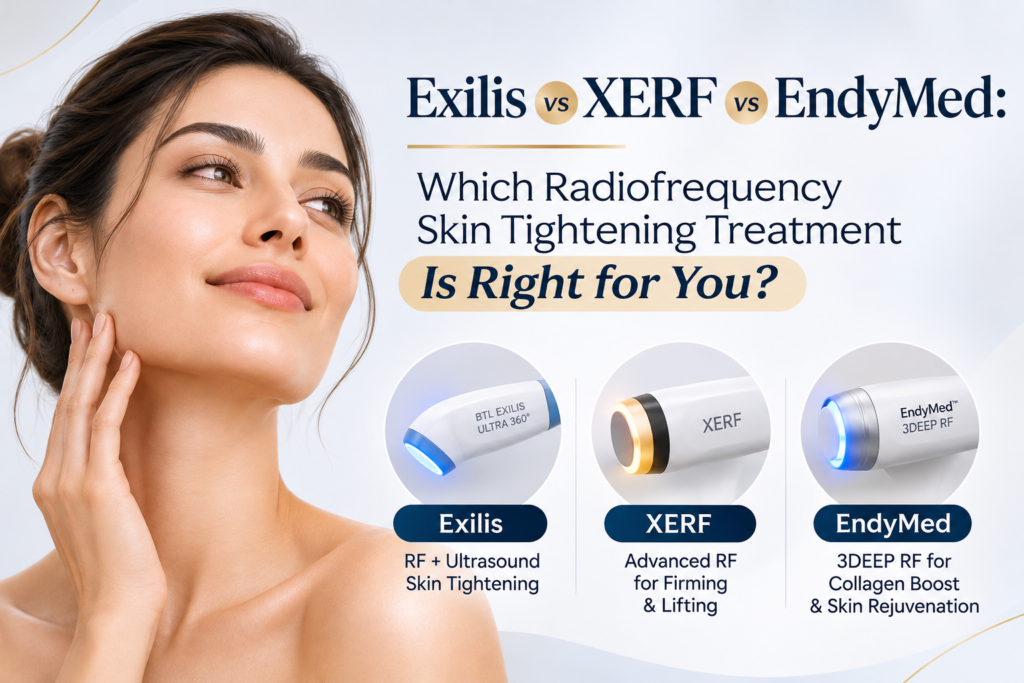
There is no single best treatment among Exilis, XERF, and EndyMed for everyone. Exilis Ultra 360 combines radiofrequency with ultrasound, XERF uses dual-frequency monopolar RF, and EndyMed uses proprietary multisource, phase-controlled 3DEEP RF technology.
Each system offers different treatment capabilities.
Exilis may be considered for selected facial and body skin-tightening concerns. XERF focuses on customizable non-invasive RF treatment at different tissue depths. EndyMed provides multiple aesthetic modalities, including non-invasive skin tightening and, on compatible platforms, RF microneedling and fractional resurfacing.
The most suitable treatment depends on the patient’s skin condition, medical history, degree of laxity, recovery preferences, and realistic expectations.
What Is Radiofrequency Skin Tightening?
Radiofrequency skin tightening is an aesthetic procedure that uses electromagnetic energy to generate controlled heat within targeted tissues.
This heating can trigger biological processes involved in collagen remodeling.
Collagen is one of the main structural proteins responsible for skin firmness and support.
As collagen and elastin change with age, the skin gradually loses elasticity. This can contribute to fine lines, wrinkles, facial sagging, and reduced jawline definition.
RF skin tightening aims to improve these concerns without surgically removing excess skin.
Although improvements may become visible over several weeks or months, results are usually more subtle than those achieved with cosmetic surgery.
What Is BTL Exilis Ultra 360?
BTL Exilis Ultra 360 is a non-invasive aesthetic system that combines monopolar radiofrequency and ultrasound energy with controlled cooling to address selected skin-tightening and body-contouring concerns.
The device is used for different facial and body treatment applications.
How Does Exilis Ultra 360 Work?
Exilis uses a combination of radiofrequency and ultrasound energy to generate controlled tissue heating.
This thermal effect encourages collagen remodeling and can support gradual improvements in skin firmness.
Its cooling and monitoring features help the practitioner manage the treatment experience.
Potential Benefits of Exilis
- May improve mild to moderate skin laxity.
- Can be used for selected facial and body areas.
- May improve the appearance of fine lines.
- Offers non-invasive treatment protocols.
- Generally involves minimal recovery time.
- May address selected body-contouring concerns.
Who Might Consider Exilis?
Exilis may be considered by adults with mild looseness around the cheeks, jawline, neck, abdomen, arms, or thighs.
However, it is not a weight-loss treatment and cannot remove substantial excess skin.
What Is XERF Skin Tightening?
XERF is a non-invasive radiofrequency treatment developed by Cynosure Lutronic that combines 6.78 MHz and 2 MHz frequencies to deliver controlled heating at different tissue depths.
The system is designed for customizable skin-tightening treatments.
How Does XERF Work?
XERF uses dual-frequency monopolar radiofrequency energy with adjustable depth and intensity settings.
The system includes Wave Fit pulse technology and integrated cryogen cooling to control energy delivery and help protect the skin surface.
XERF also uses impedance feedback to support individualized treatment settings.
Potential Benefits of XERF
- Designed for non-invasive facial skin tightening.
- Supports customizable depth settings.
- May improve early facial skin laxity.
- May improve the appearance of mild lower-face sagging.
- Usually involves little or no routine downtime.
- Does not require needles for standard treatment.
Who Might Consider XERF?
XERF may be suitable for selected adults with early facial laxity who prefer a non-invasive procedure.
Patients seeking significant lifting of pronounced jowls or substantial excess skin may need a different approach.
What Is EndyMed 3DEEP RF?
EndyMed 3DEEP is a multisource, phase-controlled radiofrequency technology designed to deliver controlled thermal energy into targeted tissues for aesthetic skin treatments.
Unlike a single-purpose device, EndyMed is a technology platform that supports several treatment modalities.
How Does EndyMed Work?
EndyMed uses multiple RF energy sources and electronically controlled energy fields.
Its 3DEEP technology manages the interaction between these fields to create a targeted heating pattern within the tissue.
Depending on the system and applicator, EndyMed can support non-invasive tightening, fractional RF resurfacing, and RF microneedling.
Potential Benefits of EndyMed
- May improve mild skin laxity and wrinkles.
- Supports non-invasive facial rejuvenation.
- Offers selected body-treatment applications.
- Compatible systems can provide fractional RF resurfacing.
- Some systems support RF microneedling for selected skin texture concerns.
- Allows treatment planning across different aesthetic indications.
Who Might Consider EndyMed?
EndyMed may be considered for patients with skin laxity, certain wrinkles, or texture concerns, depending on the modality.
For example, EndyMed Intensif RF microneedling is substantially different from external, non-invasive RF tightening and involves additional risks and recovery requirements.
Exilis vs XERF vs EndyMed: Detailed Comparison
| Feature | BTL Exilis Ultra 360 | XERF | EndyMed 3DEEP |
|---|---|---|---|
| Core technology | Monopolar RF + ultrasound | Dual-frequency monopolar RF | Multisource, phase-controlled RF |
| Main applications | Skin tightening and selected body contouring | Non-invasive skin tightening | Skin tightening and additional platform-dependent treatments |
| Facial treatment | Yes | Yes | Yes |
| Body applications | Yes | Device/protocol dependent | Yes, on compatible systems |
| Adjustable treatment delivery | Yes | Three depth settings and ten intensity levels | Depends on system and applicator |
| Cooling approach | Integrated cooling | Cryogen cooling | Energy-field control; requirements vary by applicator |
| Needles required | No for standard treatment | No | Only for certain modalities, such as Intensif |
| Downtime | Usually minimal | Usually minimal | Minimal for non-invasive RF; greater for invasive modalities |
| Results | Gradual, variable | Gradual, variable | Gradual, modality-dependent |
Important: This comparison describes technological differences, not clinical superiority. Direct, high-quality head-to-head research comparing all three devices is limited.
Which RF Treatment Is Best for Face Tightening?
All three technologies offer applications relevant to facial skin laxity.
Exilis combines RF and ultrasound heating for selected facial rejuvenation concerns.
XERF offers dual-frequency RF and several depth settings for non-invasive skin tightening.
EndyMed uses multisource RF technology, with different facial treatment options depending on the selected applicator.
The best RF treatment for facial tightening is the one that appropriately addresses your specific skin condition with an acceptable safety profile and realistic expected outcome.
Device popularity alone is not a reliable way to select treatment.
Which Treatment Is Better for Jawline Tightening?
Jawline concerns can result from several factors, including skin laxity, facial fat distribution, reduced structural support, and anatomical changes.
RF treatment may improve mild looseness around the lower face.
However, it cannot reliably correct every cause of jowling or poor jawline definition.
Exilis, XERF, and suitable EndyMed treatments may all be considered in specific circumstances.
A dermatologist should first determine what is contributing to the change in jawline appearance.
For substantial skin sagging, surgical lifting may provide a more effective result.
Which Treatment Is Better for Wrinkles and Fine Lines?
The appropriate procedure depends on the type and cause of wrinkles.
Fine lines associated with reduced skin firmness may respond to collagen-remodeling treatments.
Exilis and XERF focus on non-invasive RF treatment approaches.
EndyMed offers non-invasive RF options and additional resurfacing modalities that may be considered for certain skin texture concerns.
However, wrinkles caused primarily by repeated facial muscle movement or significant volume loss may require other approaches.
Not all wrinkles respond equally to skin tightening.
Which Is Better for Skin Tightening After Weight Loss?
Skin laxity after weight loss can range from mild looseness to substantial folds of excess skin.
Exilis and selected EndyMed protocols may be considered for mild body skin laxity.
XERF is primarily promoted for non-invasive structural skin-tightening applications, with exact treatment areas depending on the device and provider protocol.
For substantial excess skin following major weight loss, non-invasive RF is unlikely to replace surgical skin removal.
A professional assessment is necessary to determine whether an energy-based treatment is likely to provide meaningful improvement.
Exilis vs XERF vs EndyMed: Which Treatment Is More Comfortable?
Comfort depends on the device, energy settings, treatment area, and individual pain tolerance.
Exilis Comfort
Patients generally experience a warming sensation as the applicator delivers energy.
Cooling technology helps manage surface temperature.
XERF Comfort
XERF incorporates integrated cryogen cooling and controlled pulse delivery.
Many treatment protocols are designed to avoid the need for numbing anesthesia.
EndyMed Comfort
Non-invasive EndyMed RF generally produces warmth during treatment.
However, EndyMed fractional resurfacing and RF microneedling may require topical anesthesia and have a different recovery profile.
No treatment should be described as completely painless for every patient.
Which RF Treatment Has the Least Downtime?
Standard non-invasive Exilis, XERF, and EndyMed skin-tightening treatments generally involve minimal downtime.
Patients may experience temporary redness, swelling, warmth, or tenderness.
However, EndyMed Intensif RF microneedling and fractional RF resurfacing are not equivalent to non-invasive RF tightening.
These more intensive procedures may involve redness, swelling, temporary skin changes, and additional aftercare.
The exact recovery period depends on the selected procedure.
How Many Sessions Are Needed for Exilis, XERF and EndyMed?
There is no universal session count for any RF system.
| Treatment | General treatment approach |
|---|---|
| Exilis Ultra 360 | Commonly delivered as a course of multiple sessions |
| XERF | May be performed as a single treatment or additional sessions depending on assessment |
| EndyMed 3DEEP | Often a course of sessions for non-invasive RF; other modalities have different protocols |
A qualified professional should recommend a schedule based on skin condition, treatment area, device parameters, and individual response.
Patients should be cautious about guaranteed results after a fixed number of sessions.
When Will Results Become Visible?
RF skin-tightening improvements generally develop gradually.
Some patients notice an initial tightening effect after treatment.
More noticeable changes may emerge over the following two to six months as collagen remodeling progresses.
The timeline depends on treatment technology, number of sessions, skin condition, and individual response.
The initial effect may not represent the final outcome.
How Long Do RF Skin Tightening Results Last?
The duration of results varies.
Non-invasive RF treatments may produce improvements lasting several months or longer, but results are not permanent.
Some patients may benefit from maintenance treatment.
Natural aging continues, and factors such as sun exposure, weight fluctuations, and skin health can influence the appearance of results.
There is insufficient evidence to promise that one of these three technologies will consistently provide the longest-lasting result for every patient.
Are Exilis, XERF and EndyMed Safe for Indian Skin?
Radiofrequency skin-tightening treatments may be suitable for a wide range of skin tones, including Indian skin tones, when the appropriate technology, settings, and patient selection are used.
RF energy does not primarily depend on melanin absorption in the same way as some laser treatments.
However, this does not eliminate the risk of burns, irritation, or pigmentation changes.
Patients with darker skin tones may develop post-inflammatory hyperpigmentation following tissue injury.
Risks are particularly relevant when comparing non-invasive RF with fractional or microneedling procedures.
A trained medical professional should review skin type, medical history, and possible contraindications before treatment.
What Are the Risks of Radiofrequency Skin Tightening?
Common temporary reactions may include:
- Redness.
- Warmth.
- Mild swelling.
- Tenderness.
- Temporary sensitivity.
Uncommon but potentially more serious complications include burns, pigmentation changes, and scarring.
Certain invasive RF procedures have additional reported risks, including unwanted fat loss or nerve injury.
Patients who are pregnant, have relevant implanted medical devices, active infections, or other medical conditions may not be eligible for some treatments.
A consultation should include an explanation of the specific device’s risks and contraindications.
Can RF Skin Tightening Replace a Surgical Facelift?
No. Exilis, XERF, and EndyMed cannot reliably reproduce the degree of lifting and correction of substantial facial sagging achieved through facelift surgery.
Non-invasive RF treatments are generally considered for patients seeking subtle to moderate improvements without surgery.
Surgical facelifts are designed to reposition deeper facial tissues and remove excess skin when appropriate.
For patients with mild laxity, non-invasive procedures may provide an attractive alternative.
For patients with significant sagging, a surgical consultation may be more appropriate.
How Much Do Exilis, XERF and EndyMed Treatments Cost in Ahmedabad?
Treatment costs vary depending on the technology, treatment area, number of sessions, clinic, and individualized plan.
A single-session procedure may have a higher upfront cost than one appointment within a multi-session course, but that does not necessarily mean the overall treatment is more expensive.
When comparing costs, patients should ask about:
- Total recommended sessions.
- Price of the complete treatment plan.
- Consultation and follow-up charges.
- Expected outcomes and limitations.
- Possible maintenance requirements.
- Any additional aftercare expenses.
Avoid choosing a medical aesthetic treatment based exclusively on the lowest price.
How to Choose the Right RF Skin Tightening Treatment
Before selecting an aesthetic procedure, consider the following questions.
1. What Is Your Main Skin Concern?
Fine lines, sagging skin, loss of facial volume, and excess fat are different concerns.
Each may require a different treatment approach.
2. How Much Skin Laxity Do You Have?
Mild laxity may respond to non-invasive RF.
More significant sagging may require alternative procedures.
3. Do You Want to Avoid Downtime?
If minimal recovery is important, non-invasive options may be more suitable than fractional resurfacing or RF microneedling.
4. What Results Are Realistic?
Ask the treating professional what degree of improvement can reasonably be expected for your skin condition.
5. Is the Treatment Appropriate for Your Medical History?
Medical history, implanted devices, skin conditions, and other contraindications can affect treatment suitability.
6. What Evidence Supports the Recommended Device?
Ask about the evidence for the specific treatment, not just the technology’s general marketing claims.
Radiofrequency Skin Tightening in Ahmedabad: Why Consult Dermet Clinic?
Choosing between aesthetic technologies can feel confusing, particularly when each device is promoted with different technical features and treatment benefits.
A professional dermatology consultation can help identify the underlying cause of a skin concern and determine whether RF tightening is a reasonable option.
At Dermet Clinic in Bodakdev, Ahmedabad, patients can seek professional guidance for skin aging, aesthetic rejuvenation, and non-surgical skin-tightening concerns.
Dermet Clinic’s approach to dermatology and aesthetic care emphasizes personalized treatment planning based on individual needs.
Rather than selecting a treatment solely because it is trending, patients can benefit from understanding their skin condition, treatment alternatives, and expected outcomes.
Frequently Asked Questions: Exilis vs XERF vs EndyMed
1. Which is better: Exilis, XERF or EndyMed?
There is no universally superior device. Exilis combines RF and ultrasound, XERF uses dual-frequency monopolar RF, and EndyMed uses multisource 3DEEP RF. The best choice depends on skin condition, treatment goals, and medical suitability.
2. Is XERF better than Exilis for face tightening?
XERF has customizable dual-frequency RF settings, while Exilis combines RF and ultrasound. There is insufficient direct comparative evidence to conclude that one consistently produces better facial tightening results.
3. Is EndyMed better than XERF for wrinkles?
Both have wrinkle-related treatment applications. EndyMed also offers certain fractional and microneedling modalities, but these have different risks and recovery requirements. The better option depends on the type of wrinkles being treated.
4. Which RF treatment is best for jawline tightening?
Exilis, XERF, and suitable EndyMed protocols may improve mild skin laxity. The appropriate choice depends on the reason for reduced jawline definition and the patient’s anatomy.
5. Which treatment has no downtime?
Standard non-invasive Exilis, XERF, and EndyMed treatments usually involve little downtime. Temporary redness or swelling can still occur, and more invasive EndyMed modalities require additional recovery.
6. Which skin-tightening treatment gives the fastest results?
Some patients experience an early tightening effect after RF treatment, but meaningful collagen remodeling develops gradually. There is no reliable evidence that one of these devices always produces the fastest results.
7. Are these treatments suitable for Indian skin?
They may be suitable for various Indian skin tones after appropriate assessment. Device settings, treatment modality, and individual risks must be evaluated by a qualified professional.
8. Can these treatments remove a double chin?
RF may improve mild skin laxity beneath the chin, and certain technologies have contouring applications. However, excess fat and anatomical factors may require different treatment approaches.
9. Are RF skin-tightening results permanent?
No. Improvements are temporary, and natural skin aging continues. Some patients may require maintenance treatments.
10. Where can I get advice about RF skin tightening in Ahmedabad?
Dermet Clinic in Bodakdev, Ahmedabad, offers dermatology and aesthetic consultations to help patients explore suitable treatment options for skin aging and laxity.
Final Verdict: Exilis, XERF or EndyMed?
BTL Exilis Ultra 360, XERF, and EndyMed 3DEEP represent different approaches to energy-based skin rejuvenation.
Exilis Ultra 360 combines radiofrequency and ultrasound and is used for selected facial and body aesthetic concerns.
XERF focuses on non-invasive skin tightening through customizable dual-frequency monopolar RF technology.
EndyMed 3DEEP uses multisource, phase-controlled RF technology and supports different aesthetic procedures depending on the platform and applicator.
The best treatment is not necessarily the newest, most expensive, or most heavily advertised.
It is the procedure that is appropriate for your skin concerns, medical history, treatment goals, and expectations.
Consulting a qualified dermatologist is the most reliable way to make that decision.
Explore Personalized Skin Tightening Options at Dermet Clinic, Ahmedabad
Are you noticing loose skin, early jowling, fine lines, or reduced facial firmness?
At Dermet Clinic in Bodakdev, Ahmedabad, you can discuss your concerns with a dermatology professional and explore personalized skin rejuvenation options.
A consultation can help determine whether an RF-based procedure, another non-surgical treatment, or a different approach may be suitable.
Dermet Clinic
Address: 104/105, Aaron Spectra, Rajpath Rangoli Road, Behind Rajpath Club, Bodakdev, Ahmedabad, Gujarat 380054
Phone: +91 91041 59659
Website: https://dermetclinics.com/
Book your consultation at Dermet Clinic and explore an individualized approach to skin rejuvenation.
Medical disclaimer: This blog is for general educational purposes and does not replace individualized medical advice. Device-specific treatment availability at Dermet Clinic has not been independently confirmed. Consult a qualified healthcare professional for treatment recommendations, contraindications, and expected outcomes.